March 17, 2026
Passive Monetization Is Quietly Killing Your LTV
Most indie studios believe they have monetization handled.
Ads are installed.
Revenue is coming in.
The dashboard shows numbers going up.
So everything must be fine.
But here is the uncomfortable truth:
Revenue coming in does not mean revenue maximized.
And when monetization runs on autopilot, it quietly lowers your LTV.
That is where growth starts to choke.
Let’s break this down in plain terms.
The Coffee Shop Problem
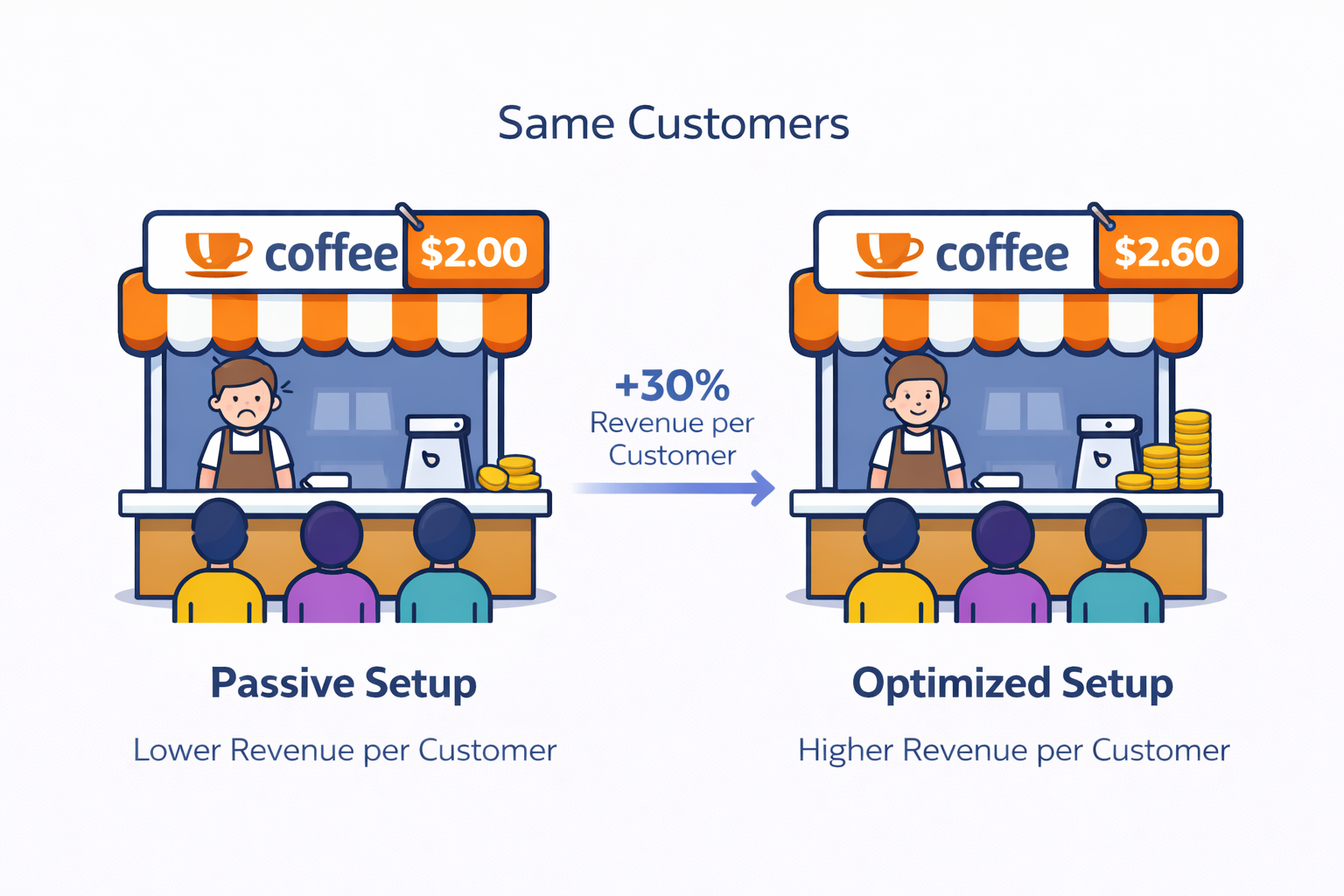
Imagine you open a coffee shop.
Customers walk in.
They buy coffee.
Money hits the register.
You are profitable.
Now imagine you accidentally priced every drink 30 percent too low.
You would still make money.
You just would not be making what you should be making.
You might even think:
“Margins feel tight.”
“Growth feels harder than it should be.”
But the issue would not be traffic.
It would be pricing.
That is what passive monetization does to your game.
It works.
It just works below its potential.
The Domino Effect No One Sees
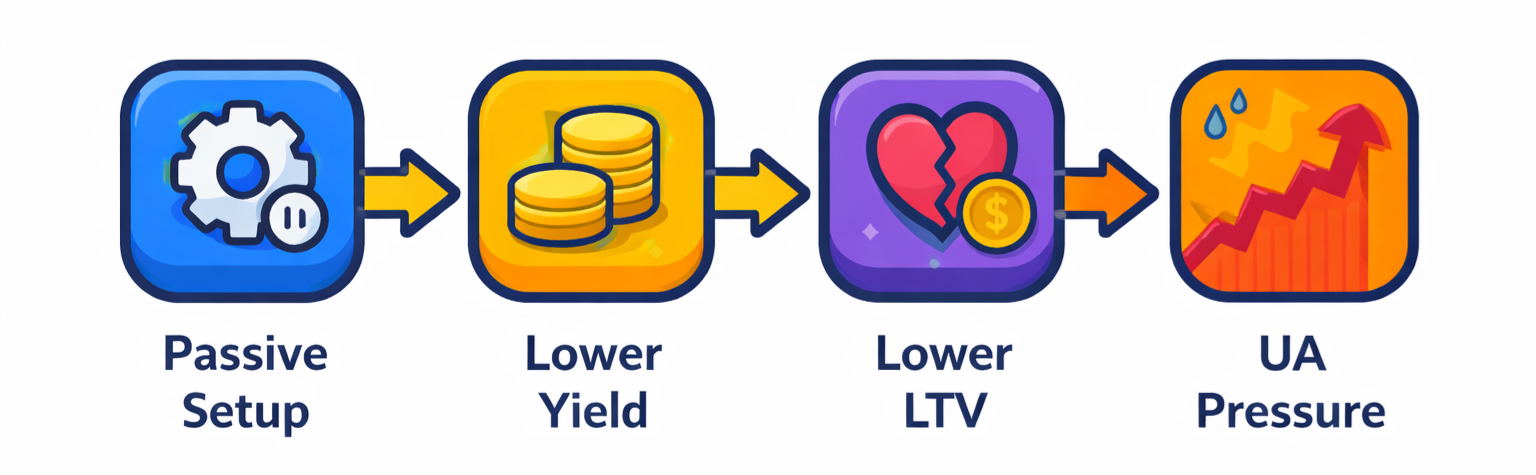
Here is what usually happens:
Passive monetization
→ Lower yield
→ Lower LTV
→ UA pressure
A small blind spot at the start creates pressure everywhere else.
This is not dramatic. It is structural.
Step 1: Passive Monetization
This is extremely common:
- Mediation installed
- One or two ad networks connected
- Default setup
- No active yield ownership
Revenue starts appearing.
The team moves on.
No one is directly responsible for asking:
“Are we earning the maximum per player?”
It is like turning on cruise control and assuming you are taking the fastest route.
You are moving.
But you are not optimizing.
Step 2: Lower Yield
Yield is simply how much money you earn per ad impression.
If your setup is basic or lightly optimized, you earn less per impression than you could.
Not zero.
Not broken.
Just lower.
At small scale, it feels invisible.
At large scale, it becomes expensive.
Think of it like a tiny leak in a water pipe.
One drop does not matter.
Millions of drops do.
Step 3: Lower LTV
LTV is lifetime value. It is how much revenue a player generates over time.
Lower yield directly lowers LTV.
And LTV determines how much you can afford to spend on user acquisition.
If your LTV is artificially capped, your growth is artificially capped.
It is like trying to build a taller building on a short foundation.
You hit a ceiling that should not exist.

Step 4: UA Pressure
Now the pain shows up.
- CPIs rise
- Margins shrink
- ROAS targets tighten
- Scaling feels risky
The team responds by:
Testing creatives.
Trying new channels.
Tweaking bids.
But they are adjusting the engine
while the fuel line is restricted.
The issue is not always traffic.
It is revenue per player.
Let’s Put Real Numbers on It
Assume your game generates:
$200,000 per month in ad revenue.
Everything looks stable.
Now imagine your setup is leaving just 30 percent on the table.
That is not extreme. That is common in single-network or lightly optimized setups.
Here is what that means:
$200,000 × 30% = $60,000 per month
That is:
$720,000 per year
From the same players.
With the same traffic.
Without increasing CPI.
You did not acquire more users.
You simply improved yield.

Why This Changes UA Immediately
If revenue increases 30 percent, LTV increases 30 percent.
If LTV increases 30 percent, you can afford to bid higher.
That means:
- More campaigns become profitable
- You win more auctions
- You scale faster
You did not fix traffic.
You fixed monetization ownership.
The Hidden Growth Constraint
Most studios do not fail because they lack tools.
They have mediation platforms.
They have dashboards.
They have access to networks.
Tools run auctions.
Dashboards report revenue.
But no one owns closing the revenue gap.
Passive monetization feels safe because money is coming in.
But growth requires ownership, not autopilot.
Monetized Is Not the Same as Optimized
Old definition of monetized:
Ads installed. Revenue visible.
New definition:
Revenue gap closed.
There is a massive difference between making money
and making the maximum money your game can generate.
One sustains your studio.
The other unlocks scale.
What You Should Do Next
Start with clarity.
You do not need to rebuild everything.
You need to answer three simple questions:
- What is our revenue ceiling?
- What uplift is realistically possible?
- Is our current setup leaving money on the table?
If you cannot answer those clearly, you are scaling in the dark.
And scaling in the dark always creates artificial limits.
At MAS, we start by estimating the revenue gap before engagement.
We model conservative uplift based on setup.
We track modeled vs actual performance.
And we take accountability for revenue lift.
Because running ads is not monetization.
Closing the revenue gap is.
If passive monetization is quietly limiting your LTV,
the first step is not more traffic.
It is visibility.
And visibility changes everything.

Table of Content