Game Growth
06.02.2022
•
5 mins read
by Alex Olthoff, Sales & Support | MAS Product Manager
At Yodo1, we pride ourselves on building a customer-centric culture and embracing best practices in product development. One such practice, a Press Release (PR) Frequently Asked Questions (FAQ), encourages the product manager to start the development of a new major feature by writing a press release and associated FAQs about the new product or feature.
In this instance, we wanted to share what a PRFAQ looks like for our latest, major Managed Ads Services (MAS) feature: Native Ads. We hope this format inspires you to think about your customers the next time you add a feature to your game/app!
Native Ads are one of the most powerful ad types for app and game developers looking to create a better ad experience for their users and players. Unlike traditional, disruptive ads, Native Ads fit right in with the rest of the app, appearing to almost be part of the content or game. Made popular by Admob for Android apps, they are now available in our monetization MAS SDK, which will increase revenue for developers using the platform, while improving the experience for their players.
While there are many viable, single ad network providers who can help developers use Native Ads, benefitting from the full power of Native Ads can be a challenge. It requires configuring a mediation provider, setting up and monitoring waterfalls, and integrating multiple ad networks into a game. This can take a week just to get set up, and far longer to optimize effectively, and often developers just choose single ad network solutions to avoid the complexity, thus sacrificing their revenue.
With Native Ads now a part of MAS, developers no longer have to struggle to access their full potential. Instead, by simply integrating MAS, they get access to the power of multiple mediations, each capable of running multiple ad networks that serve Native Ads. This means higher revenue with minimal effort.
We are excited to be bringing Native Ads to MAS. Our customers, indie developers trying to do better by themselves and their players and users, deserve an easy-to-use Native Ads solution that doesn’t require multiple ad network integrations and/or managing eCPM floors or bidding solutions.
Now, with MAS they can get a seamless experience using the ad type and an automated solution for managing monetization of all the other major mobile ad types they rely on. Native ads on MAS promises to help thousands of developers more rapidly experiment with new app and game ideas, saving time on annoying integrations and making more to boot.
Using Native ads with MAS is much like using any other ad type with MAS. Simply follow the 6-step process outlined at developers.yodo1.com (just four steps on Unity with our NO CODE PLUGIN). Our dedicated Developer Support team will be there to assist you every step of the way, and even integrate the game for you for free if you don’t have time (ask about an “Integration Assist” in our chat).
Ikram Terkini, a developer and beta tester of the new Native Ads feature, had this to say: “It was easy, and the impact on my revenue has exceeded my expectations. I hadn’t tried Native Ads before because I knew they were challenging to set up, and I struggled to find a good use case. Now, I can confidently say that using them has paid off, and it was easy with MAS.”
Another beta tester, Raul Gonzalez, commented: “I had been using Native Ads with Admob for a while. They worked fine, but I was looking to try a new solution that brought me more revenue without the challenge of working with a mediator. When Yodo1 reached out and offered to let me beta test, I said yes right away. I am glad I did, because I’ve seen an increase in revenue not only from Natives, but all ad types I use in my game.”
Are you interested in trying out MAS and getting the full benefit of Native Ads? Check out our portal to get started at mas.yodo1.com/register!
We offer two sizes: small and medium. These sizes will adapt to your application, but you can think of small as approximately the size of a large banner (250 x 100 pixels) and the large size as slightly larger than an IAB medium rectangle banner (300 x 250).
This will vary considerably depending on the app. But as a rule of thumb, you can expect to see earnings close to those from a well-placed interstitial. You can evaluate your traffic in the MAS dashboard and consider how to make your app/game more attractive to players in countries where eCPMs are higher.
The process is simple:
Typically, MAS takes 1-2 hours to integrate, but in good conditions, it can be integrated in 15 minutes! MAS is the easiest SDK in the world to integrate.
Yes! We do use Admob’s Native Ads, but the Native Ads we provide are served from a range of networks included in MAS. This means these multiple ad networks are competing effectively to make sure you get the highest eCPMs and best fill rate for the Native Ads in your game.
By comparison, Admob Native ads come from 1 ad network, Admob, which means you have no guarantee that Admob is giving you the ads that are going to bring the most revenue to you.
We pay you the revenue you earn from our ad networks every 30 days. We take a small cut from the overall payment. We deal with customers in over 100 countries with a strong payment partner, guaranteeing that you will receive your payments on time, in the currency you need, every time.
No, MAS is a Managed Ad Service, which means we use the best ad networks and ad mediators for your game. We do this using a powerful AI algorithm that has been used to increase the revenue of developers around the world by as much as 500%!
Absolutely! Our Developer Support team is best in class, and with employees, across the world, there’s always someone available to help. If you have any additional questions, please email us at bd@yodo1.com






Culture

29.01.2022
•
5 mins read

Yodo1 may have marked its tenth anniversary in November 2021, but the celebrations for a dynamic decade have carried over into 2022!
The Beijing-based start-up that began in 2011 with two visionaries and a few games to publish has evolved into a global gaming force with a player base of over 1.5 billion, built via partnerships with over 1,000 developers and 5,000 games across 50 countries.
A diverse workforce numbering over 150 across 35 countries has contributed significantly to this growth. But numbers don’t tell the whole story. So here we look at these ten years through the lens of ten team members who helped write those successful chapters.
1) What inspired you to start Yodo1? How has it evolved since then?
Games have always been a passion, and Yodo1 was an opportunity to combine that passion with my work. We founded Yodo1 as smartphones transformed the way people played games and built them, where one or two-person teams could now bring their games to life and reach a global audience through smartphones.
Yodo1 was founded to enable these indie teams of game developers not just to make great games and a great living out of these games. I look forward to helping more game developers turn their games into multi-million dollar franchises.
—Henry Fong, Co-founder, and Co-CEO, Australia
2) What do you love most about being a part of the gaming industry? And what are the challenges?
I understand the impact of customer satisfaction on businesses. Therefore I took the time to learn the skills required to be a good Customer Success Manager and obtained industry-recognized certification. Here at Yodo1, I found a perfect environment to apply my experience and refine my skill set. Every challenge I’ve faced at Yodo1 has provided me with valuable learnings required for growth, professionally and otherwise. It’s not easiest to keep up with the ever-evolving tech industry, but I look forward to constantly innovating alongside Yodo1.
—Polina Ozhylevska, MAS Customer Success Manager, Ukraine/United States
3) At the end of 2020, Yodo1 pivoted to being a fully work-from-anywhere (WFA) environment. How is that working out?
In a year, we've gone from 99% of the company being in Beijing to have almost half of our team spread out across some 25 new countries. We've brought on nearly 70 new people this year, and only a quarter was China-based.
How is it working out? The team is beautifully diverse, and I think we're doing much more than possible in the confines of an office—creativity, experiments, and overall productivity. On the employee side, people tied to Beijing for work had the freedom to return to their hometowns, see their families more, or even travel to new countries. And for hiring, we can put a job description out, and people can apply from anywhere in the world. There's no limit.
The past year has been a fantastic learning experience, and I'm looking forward to the innovations and improvements we’ll make in the new year.
—Flo Alcasas, Head of Human Resources, Netherlands
4) What are the strengths of having a multicultural workforce at Yodo1?
As a naturally curious individual, Yodo1 has provided me with a consistent learning environment and a space to think creatively and in a global context. This has served me professionally as Head of Customer Success and in my personal problem-solving approach. Operating in this environment also allows me to tap into global expertise daily, which is not only a professional advantage but also a unique privilege for me, as I have always been excited about being exposed to cultures outside my own, and I get to experience that while being gainfully employed.
—Syed Ali Shah Baacha, Head of Customer Success & Developer Support, Pakistan
5) What is the best part of working at Yodo1?
I was in the admin department when I joined Yodo1 nine years ago. Then four years later, I was given an opportunity in a vital HR role, although I had no previous experience in HR. That is Yodo1 in a nutshell. It gives you that platform to challenge yourself, learn and grow professionally, and improve your circumstances. My colleagues are also very friendly and helpful, making work all the better for me.
—Ma Jun, HR Operations Support, China
6) As a long-time employee, how do you feel about the shift to WFA?
I’ve experienced significant professional and personal growth during my ten years at Yodo1.
I joined as a young, single girl in the capacity of Marketing Manager and have gone on to get married and become a mother, all while being promoted to Marketing Director and then my current position as Head of IP Licensing.
Yodo1 has always provided a great work environment, nurturing all my aspirations and growth potential and equally supportive of my personal development by building a results-oriented foundation of trust and continuous innovation.
—Vivien Zhang, Head of IP Licensing, China
7) What do you love most about your job?
I can work from anywhere. I can travel anytime. I can live anywhere I want to live.
Yodo1 (through its smart Talent Acquisition team) recognized early that the world would change after COVID, and nobody would want to work from offices anymore. They realized that if they're going to get the best talents (and keep them), they have to offer unique advantages, and this is what they did!
They could put themselves ahead of the other companies and get the best talent because of their smart culture.
And the "killer advantage" that I found in Yodo1 is the unlimited PTO. Only a few companies offer this advantage and have this smart culture, and I'm proud to be a member of one of them!
—Ahmed Tohamy, LED Frontend Developer, Egypt
8) Do you have any advice for someone looking to get into gaming as a career?
The gaming industry is diverse and has a lot to offer. You don't have to play or create games to be part of it. You get to work on solutions to problems touched by millions of players worldwide.
As an engineer, I witnessed firsthand Yodo1’s emphasis on independence, leadership, and ownership. The company promotes better habits, helps employees set clear goals (personally and professionally), and incentivizes them to succeed. We welcome anyone who wants to make the world more playful, one game at a time.
—Nitesh Oswal, LED Lead, India
9) How did you get into this field, and what do you like about it?
I worked for one of Co-CEO James' startups and liked the working environment and culture. I wasn't a gamer, but the fact that James encouraged me to try my skills in a new industry gave me the courage to try. The results have changed my life, and it all started when I took the first step, enrolling in the MAS BD Course.
I love that I can work virtually, which any mom would appreciate. I also have had a forward-thinking, supportive manager, Marina (Espin, Head of Sales & Support) who has guided and mentored me? I have learned a lot from her and look forward to learning more. I also enjoy working one-on-one with developers from all over the world, which has allowed me to develop my ability to communicate clearly, not only with them but also with other team members.
—Tsitsi Chogah, Legion Team Lead, South Africa
10) Where would you like Yodo1 to be in another ten years?
We believe both Web 3.0 and the digital creator economy will be centered around the number one form of entertainment: video games. Yodo1 is committed to being THE platform that supports all game developers with an easy-to-use yet powerful platform of monetization tools, business support, and education offerings to enable developers worldwide to turn their games into scalable businesses.
—James LaLonde, Co-Founder, and Co-CEO, China
Will You Join Us for the Next Ten?
Powered by diversity and inclusion, Yodo1 will continue to innovate its service offerings into the next decade as a critical player in this growing, global industry.
If you read this through to the end, you’re either curious, passionate, or both as they relate to gaming and Yodo1 culture. Would you like to help us write our next successful chapters?
Check out our Careers page to learn more and discover open WFA roles.

Game Growth
16.12.2021
•
5 mins read
With 2022 almost here, it is the perfect time for game developers to analyze what worked, what didn’t and make plans so their games become better and better. Monetization is a major part of this. No matter if you are a small or big developer, there are always ways your strategy can be improved to increase your revenue.
Of the three major ad types most mobile game developers depend on—banners, interstitials, and rewarded videos— the latter two typically generate the bulk of a game’s revenue. They may get all the love, but banner ads are an important tool, too, and shouldn’t be ignored. There are some long standing biases towards banners from many in the development community: let’s take an objective look to sort facts from bad press.
One of the most common misconceptions is that banners are highly disruptive to the user experience. However, it’s not fair to banners to say they cause bad UX; the ugly truth is it’s developers who create bad UX for their users with banners.
Some classic examples include banners covering UI elements, banners popping up in the middle of game play, or adding too many to the screen, completely taking players out of an immersive game play experience. However, while all the above can be issues with banners when used poorly, interstitials are actually the more disruptive ad type, since when they show the whole game is interrupted.
By contrast, when used well, banners can actually feel almost pleasant in the game play experience. For example, medium rectangle banners on pause screens, victory screens, and game over screens give players something else to consider in case they are bored. Similarly, smart banners can add considerably to landscape games, reminding players to check out something they may want to consider later without compromising gameplay.
Another persistent belief about banners is that they don’t generate enough revenue to be worth using, but they can contribute an average eCPM of $0.50, which can translate to $500 or more if a developer gets over a million banner impressions in a month. In addition, some banner types can even deliver a higher eCPM, and more revenue. As an example, adaptive banners have a 20% higher eCPM, putting them up there with interstitials in terms of revenue.
Finally, it’s worth noting that there’s often at least a positive causal relationship between the presence of banners and the purchase of IAP to get rid of advertising in a game. While it’s always important to test what’s true for your game, you’re potentially leaving IAP money on the table if you completely ignore them.
That being said, this last bias has a kernel of truth in it for one particular scenario: non-standard banner sizes. For those not familiar, non-standard banner sizes are any banner sizes other than 320x50.
Why do these other banner sizes have a somewhat lower fill rate? The reason differs by size.
320 x 100, for example, is only served by Admob , and this means a slightly lower overall fill rate.
Finally, medium rectangle banners are only supported by Admob and FAN, again lowering fill rate slightly.
Overall though, the fill rate for these other sizes is only nominally lower, and a savvy ad monetization solution can still help developers get the maximum fill rate from these banner sizes.
Like most things in life, the key to great ad monetization is balance, and banners definitely have a place in a balanced ad strategy.
The key is to use a great ad monetization partner that makes sure you are getting the most out of the banner ad type. Yodo1’s top-performing mobile game monetization SDK, Managed Ad Services (MAS) 4.4, now includes all of the above-mentioned five banner sizes, giving you even more choices.
Take advantage of our Holiday Welcome Bonus and get $25 today when you release your first game using MAS. This offer is valid until December 31, 2021, so sign up today and see how much a service that favors developers can increase your bottom line.
Culture

06.12.2021
•
5 mins read
At Yodo1, we believe that the gaming industry should be open to everyone with an interest, no matter their skill level or experience. Our free courses and training sessions allow anybody who loves gaming to fulfill their dreams of working in the industry.
Many people are drawn in by a personal interest, of course, but some have also come to Yodo1 thanks to a series of happy coincidences.
Ismael from Alicante, Spain, wasn’t part of the gaming industry—he’d worked various jobs, mostly in tourism, and was helping some of his friends with translations and marketing for their mobile gaming studio.
“Yodo1 contacted my friends and they don't speak English. So they asked me to look into it and do some research.” He thought he’d just give the company a quick look-over, but when he went to Yodo1’s website and started reading up on the products, he was impressed and wanted to learn more about it.
Ismael found the Managed Ad Services (MAS) BD Certification Course and realized that MAS was the product his friends were being offered: a platform that helps mobile game developers optimize the revenue from their games.
Curious, Ismael signed up for the free course. “I thought if I took the course then I’d be ready, see if there was a catch, and avoid any surprises.”
But after taking the course, Ismael had no doubts. “I told my friends that this platform could definitely be helpful to outsource monetization and optimize revenue.”
Ismael dove into the business side of gaming, studying up to twelve hours some days to get a handle on the terminology, industry trends, etc. At first, he felt lost and found it overwhelming, but he kept at it.
His friends’ studio had decided to integrate MAS, and just a week later, “I got an email from Yodo1 telling me I’d passed the course...and that's how everything started,” says Ismael, with a wide smile.
Ismael’s new job involved speaking to game developers around the world, helping them onboard the MAS platform and teaching them how to use it effectively. Each morning, he began by preparing for the day’s upcoming calls by playing the developers’ games and researching them online, seeing how MAS could help them.
In addition to the flexibility and the constant opportunities for learning and growth, Ismael found the Yodo1 Team to be one of the best parts of his new job. “This team is amazing. Every time I needed some help, they were there. And I really love the personal connection with our community partners. Of course, I recommend the product, but it’s not just selling for selling’s sake.”
He also discovered a strong, collaborative team spirit: “Here, we work towards what’s best for each developer, and for the company; it’s about we, not I. We look for what’s best for the team, always. And I love it.”
Ismael took up the challenge, refusing to be intimidated by the amount of work and new information. And it has paid off in spades! Only a few short months later, Ismael was offered a full-time position as a Customer Success Manager at Yodo1, a challenge that he embraced with open arms, thanks to the experience he developed in the MAS BD Rep program.
Ismael hopes his story provides encouragement and motivation for anyone who’s thinking about taking the MAS BD Certification Course that if they give their best shot, they can be a part of the gaming industry, too.
When asked to describe the atmosphere of working in a team at Yodo1, Ismael’s reply was clear and joyful: “Family, laughs, and team spirit. I know they have my back every time. No matter what happens. Also, Yodo1 likes you to be curious. And this all began because I was super curious.”
Game Growth

08.08.2021
•
5 mins read
User acquisition—or UA—is how you bring new users to your app. It is a strategy for generating the kind of interest in your game that keeps inspiring more people to install and join the fun.
UA videos—often referred to as creatives—are the most common tool but an optimal approach will also include social media campaigns, influencer collaborations, and a killer app store optimization strategy to drive players from first impression to installation.
In this article, we’ll get you started with the what, how much, and when of successful UA campaigns. For more game optimization guides, as well as important industry updates, follow Yodo1 on LinkedIn.
UA videos are an excellent tool for attracting new users, so let’s take a look at how you can optimize your creatives with topics and themes that will appeal to your audience—taking into account their behavior and psychology.
To attract new players and recapture those who have lost interest, here are some examples of videos that can be interesting and useful:
To succeed in UA, you’ll also need:
Product knowledge. Your marketing team must have a solid understanding of the game, its selling points, genre, and potential audience, before starting any UA efforts.
Creative thinking. To appeal to the users you are trying to attract.
Player psychology. To make creative videos based on the players’ preferences and pain points.
Localization: To make your game design and content fit your target markets.
Data analysis. To monitor performance throughout, adjusting and optimizing your UA strategy as needed.
When it comes to profitability numbers, UA boils down to one simple formula: making a user’s CPI (cost per install) lower than their LTV (life-time value).
To build your UA strategy, we’ll first concern ourselves with CPI. How high this ends up being depends on multiple factors:
UA isn’t cheap, and the best way to make sure you’re investing wisely is to get other aspects of your game ready before the launch of your next ad campaign.
Before trying to acquire new users, you need to make sure the ones you already have are staying. If the players you attract organically are downloading your game, playing for five minutes, and abandoning it, the money you invest in UA will end up wasted.
In other words, without retention, your ad spend is more likely to generate a negative ROI. But when you achieve a good retention rate—for example, by engaging your players in a community or by using game mechanics that keep players coming back—you’ll be in a good place to start a UA campaign.
You’ve got to spend money to make money, but you’ve got to make money to spend it. Alongside retention, you have to optimize your monetization strategy if you want a worthwhile UA budget.
Maintaining a game’s cash flow is critical to sustaining UA efforts, especially for small studios—because you won’t see the full return on investment in the form of LTV until the first 12 months have passed.
With rising user acquisition costs, mobile games that aren’t optimally monetized will run out of cash and the ability to attract new players through ads.
Yodo1’s gaming services platform can help you achieve the metrics you need to start successful UA campaigns.
Our Managed Ad Services (MAS) system combines fully automatic AI-powered ad optimization with the advantages of manual customization to help developers stabilize and increase cash flow.
This frees up time to invest in retaining users through community management, which is what our KTplay platform is all about.
Once your retention and monetization are where they need to be, our global UA experts will guide and advise you in the selection of channels, users, and ad formats, as well as help in the creation process—so you can successfully acquire new users in a myriad of markets.
Contact us at bd@yodo1.com for help elevating your game.
Yodo1 is a game platform company that helps developers better market, manage, and monetize their games. Our AI-powered tools and global expertise in areas such as mobile advertising, community management, and digital IP licensing enable partners to increase playtime, revenue, and retention. Our vision is to open the world of gaming success to anyone with the talent to develop. To learn more, visit yodo1.com and follow us on LinkedIn.
Culture

13.07.2021
•
5 mins read
While some companies are making work from anywhere (WFA) an option, Yodo1 has spent the last two years gearing up to go all the way. On December 1, 2020, we will complete our transition to fully remote by closing the doors of our Beijing office and opening our company to an environment free of traditional work boundaries.
Given its intrinsically global nature, we believe the marriage of remote work and the gaming business is a perfect match. To advance our mission of helping developers around the world turn their games into scalable businesses, we’re building a completely distributed workforce and looking for the best talent available regardless of location.
“I see Yodo1 evolving toward a company where teams can be fluid. The talent we need to fulfill our goals is not concentrated in one place.”
—Henry Fong, Co-founder & CEO
The switch to remote work is also an opportunity for us to put more control in the hands of our employees, as we create versatile, cross-continental teams to serve our partners’ needs in every timezone.
“We trust our employees to make the right decisions for the company and themselves. Our culture of transparency and autonomy empowers and incentivizes our teams, which in turn helps us better serve our partners.”
—James LaLonde, Co-founder & Chief Revenue Officer
COVID-19 was an obvious catalyst. At the start of the pandemic, with both co-founders and half of the core management team stuck outside of China, we quickly experimented with a mobile work framework to keep our company running smoothly.
By March, our entire staff—already scattered across the globe—was set up on an all-in-one business communication platform.
As China began reopening, we made coming to the office optional. Occupancy has since been well under 30 percent.
At the same time we’ve expanded our gaming services platform and grown the size of the teams significantly: doubling our revenue, remotely hiring several dozen new team members, strengthening our online presence, and launching two courses for the new Yodo1 Education platform.
“When I first heard of the switch to fully remote, I was excited that I could work anywhere. I took the plunge and left Beijing to relocate to my hometown of Shanghai. Honestly, I was also a little concerned that it would really work. Initially, it was a challenge but I’ve found that we’ve actually become more efficient.”
—Sun Ke, Head of Publishing
To make the transition as smooth as possible, we have spent this year constructing a plan that puts employee safety and comfort first. It covers three main areas.
We’ve made sure that everyone on the Yodo1 team is receiving ample allowance for home office equipment so they can create a work-from-anywhere setup that works for them.
“My favorite thing is not having to wake up super early in the morning and commute to the office. Those hours are mine now. My least favorite part is not seeing my coworkers in person. But I talk to them on a daily basis, as friends.”
—Chaula Bherti, Monetization Strategist
Yodo1 will no longer be in the business of owning and maintaining equipment; instead, employees will use their home office allowance to buy, own, and care for their own equipment.
We’re a gaming company, and we want our employees to have fun. At the office, Yodo1 hosted and sponsored several social gatherings—a favorite being Pitch Club, a hub to help people in and out of the company practice and improve their pitching skills.
This weekly event has always been open to anyone, but before COVID-19 it was limited to those in Beijing. When the coronavirus forced us to take the event online, Pitch Club grew and opened its doors to anyone, anywhere.
Internally, our team managers host virtual happy hours and group get-togethers to keep members connected on a human level.
“Communicating well has always been an essential element of working at Yodo1 and it’s one of our strengths. Now we are taking that to the next level.”
—Sonali Varma, Publishing Manager
“When you’re remote, you have to make a bigger effort, both as a team manager and as a team member, to build connections through a camera. It’s possible, but it requires effort. In our case, from our learning corner on Monday to happy hour on Friday, we have some time almost every day where the whole team talks and connects. I also initiate a lot of one-on-one communication with my team.”
—Marina Espin, Head of Business Development
Last but not least, we are using this opportunity to put more control in the hands of our employees by removing the red tape and rules that are associated with traditional workplaces.
Yodo1’s remote employees can take full advantage of our new work culture and take as many days off they like, as long as they fulfill their work obligations. We are removing all limits on vacation time.
Our people will own their equipment, their schedule, and their decisions.
“Though I was sad at the thought of not meeting my new colleagues in person, I was immediately excited by the opportunities of working from anywhere. Right now I’m in Hainan, a tropical island where the weather is amazing and I can go surfing on the weekend. And I look forward to eventually being able to spend part of the year in my home country, Italy.”
—Filippo Armani, Business Development Manager
As the gaming industry continues its fast-paced growth, Yodo1 sees a future with remote teams spread across the globe, fulfilling our corporate mission of helping game development studios of all shapes and sizes achieve success in local and global markets.
And Yodo1 is hiring! We need new business development associates to help us get products such as our Managed Ad Services across the world. For remote job opportunities in the fast-growing game industry, check out our Careers and Education pages.
“I believe it’s a blessing that the gaming industry can afford to go remote and that we can work with the same efficiency from anywhere in the world.”
—Redwan Reyadh, Monetization Strategist
Yodo1 is a game platform company that helps developers better market, manage, and monetize their games. Our AI-powered tools and global expertise in areas such as mobile advertising, community management, and digital IP licensing enable partners to increase playtime, revenue, and retention. Our vision is to open the world of gaming success to anyone with the talent to develop. To learn more, visit stg-wwwyodo1com-newtheme.kinsta.cloud and follow us on LinkedIn.
Culture

10.07.2021
•
5 mins read
How many times have you found yourself in a situation where you wish you had communicated your ideas in a clearer, more effective way? Whether you’re looking for a new job, buying a house, founding a startup, or interacting with people in the day-to-day, life constantly requires you to pitch.
“According to most studies, people’s number one fear is public speaking. Number two is death. Does that sound right? This means to the average person, if you go to a funeral, you’re better off in the casket than delivering the eulogy.”
- Jerry Seinfeld
Everyone, from every walk of life, can benefit from improving their communication skills, and developing this has been a priority at Yodo1 from day one. That’s how and why Pitch Club was born.
Pitch Club is an event and a community—of like-minded individuals who are passionate about stories, ideas, and self-improvement. We provide a safe and honest forum of peers where anyone can learn to better express their ideas.
It was first launched by serial entrepreneur James LaLonde, co-founder and co-CEO of Yodo1 Games, in Beijing, China. The impetus for starting Pitch Club was to provide a forum where people can get actionable feedback on their pitches in real time,so they can practice and make rapid improvement in their pitching and communication skills.
What started as a small face-to-face gathering has now grown into a global event, uniting participants from around the world over video conferencing.
The event has become so successful that we are launching a new chapter today! Starting on May 20, Pitch Club Chapter 2 will be hosted every Thursday from 5:30 to 7 pm GMT, making the event more accessible to those in Europe, Africa, and the USA.
No one said pitching effectively was easy. Only by deliberate practice and in-the-moment peer feedback can we improve our public speaking skills. Pitch Club exists to remove the fear and encourage pitchers to grow strong and confident, able to effectively share ideas for better outcomes in work and life.
Put quite simply, at Pitch Club our mission is to empower everyone to become the best communicator they can be—and have a great time in the process!
We believe in deliberate learning. By receiving real-time, honest feedback about your pitch, you will be able to iterate and improve on your communication skills. We give feedback in three ways:
1. Written Feedback. An anonymous online survey completed by the audience immediately after your pitch.
2. Video Recording. A recording of your pitch, delivered personally to you online so you can analyze and evaluate your own performance.
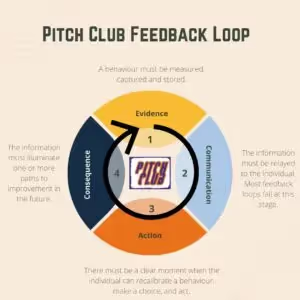
3. Realtime Feedback. The “Pitch Club Feedback Loop'' session after the pitches are completed is a highlight of every event. This interactive, face-to-face finale is where you get open and honest feedback and encouragement from your peers.
Since it was established in June 2019, Pitch Club has hosted over 150 events with participants from all seven continents and pitches by everyone from high schoolers to top executives. Altogether, over 750 pitches have been presented!
Alex Olthoff on what he’s learned from pitching: “On a fundamental level, Pitch Club is about communication and ideas. For me that’s such an essential skill: to be able to convey ideas in terms of structure, and convey emotion in a way to persuade others—which are the objectives of communication. It ties into what I value for my own personal identity, which is to be a leader and entrepreneur. Pitching is critical if you want to be one or both of those things, and there’s no better place to practice conveying structure and emotion than in Pitch Club. There’s definitely a sense of community at Pitch Club. You want to be the best and push yourself. At the same time, you get to be appreciated and seen by others for expressing who you are and how you think.”
Kai Liang is also an enthusiastic pitcher: “I have thoroughly enjoyed the participation of a lot of other wonderful and improving pitchers in the club, the positivity and spirit from the Pitch Club organizers, and the community. Life's a pitch and pitching is required everywhere in life. I have been a very confident speaker at international conferences, but more as a matter of necessity than as a result of formal training. So it was amazing to be involved in this living school of speaking where I can improve with everyone else while learning so much about other cultures, other ideas and most wonderfully, other lives. Over a short space of time, I have gained friends I can trust and share everything with. This is far more valuable and rewarding than business deals.”
By joining Pitch Club, which costs nothing but your time, you will see visible improvements in the way you communicate your ideas in every part of your life.
“Wow wow wow! Pitch Club has been an amazing learning ground to test and improve many startup pitches; helped hundreds of people to improve their pitching and communication skills, and is a beautiful community. Our growth mindsets and the joy we feel giving others feedback, thus helping them improve, is what unites us at Pitch Club.”
Jonas Wolf - Current Host of APAC Pitch Club @TheGrowthWolf
With more people joining Pitch Club every day, we continue to find new ways to learn and grow together, building on our vision that being a good communicator is a valuable skill that everyone can achieve! We are expanding into new realms and we’d love for you to come on the journey with us! Find out more about Pitch Club on LinkedIn and we hope to see you there next time!
Game Growth

08.07.2021
•
5 mins read

Have you ever wondered how your studio can use artificial intelligence to improve the playability and profitability of your mobile games?
We’ll be discussing various ways to monetize a game in future articles, but today’s focus is on how developers can enhance existing game monetization systems with IAP (in-app purchases) and give players a better experience with recommendation systems.
Recommendation systems use machine learning algorithms to predict whether users will like certain items. Unless you’ve been living in the stone age, you’re sure to have used them yourself.
Turning to the mobile gaming industry, recommendation systems come in handy when players want to, for example, buy new equipment but don’t know exactly what they need yet.
By giving new players suggestions on where to start and saving established players time by putting the items they’re interested in at their fingertips, recommendation systems make the gaming experience easier to enjoy.
Not to mention that they’ll save you time while optimizing your mobile game monetization model.
According to our data, recommendations have a definite impact on in-app purchases and mobile game revenue.
At Yodo1, our goal is to design recommendation systems so that as many players as possible can benefit from it and thereby enjoy an enhanced gaming experience.
For example, we can look at a mobile game we’ve been working on recently. We’ll refer to it here as “Robot World”.
Let’s say that, in Robot World, players have to build a team of robots and equip them with tools and special skills to attack other players’ headquarters. To build a unified team, they need to know the robots and the items available to them pretty well.
To guide our players in their decision-making, then, we needed to understand and quantify the delicate relationships between different characters’ skills and tools very well ourselves. This is where our AI team comes in, using a deep-learning technology called self-attention to build our recommendation system.
Before the recommendation system, players were buying bundled items of their own initiative and according to their knowledge of and experience in the game. However, when they weren’t sure what to get, many players simply abandoned the idea of making a purchase.
With the recommendation system, we use AI to decide which item bundles to promote based on what will be most beneficial to each individual—helping convince them of the right purchase and successfully turning even non-paying players into payers.
First, we used AI to gather data on bundles purchased by players in the past. Then the system could make the same recommendations to players in the present with similar teams and characteristics. Since we used data from experienced players, we were confident that many others in similar situations could benefit from their carefully made choices.
Second, we used the AI-powered recommendation system to better position bundles in the “Robot World” game store, making the user more willing to pay for the right item and improving our mobile game monetization.
Since the space to showcase bundles is limited—and the game has more than a thousand bundles—it was quite a task to have our operating team study the game and manually choose which ones to feature in the store. The AI system, on the other hand, can determine what to display for every individual player—leaving a lot less room for doubt than with the previous system.
With a few rounds of A/B testing, we contrasted our recommendation system based on human suggestions with our new AI-powered one. After 14 days of testing, the AI-driven system’s impression per purchase rate was 47% higher than the human system, driving a sales increase of almost 20%.
Looking forward, our objective is to create dynamic bundles tailored to every single user and their team’s characteristics—abandoning the fixed-bundle model that might contain sub-optimal items for certain players.
Overall, implementing AI in this mobile game elevated our monetization strategy and lowered the amount of human effort needed—effectively optimizing IAP monetization and increasing revenue without major human resource costs.
At Yodo1, we have built an AI-powered product suite of services to help make games around the world more playable and more profitable. Our monetization, marketing, and publishing teams are ready: simply contact us at bd@yodo1.com to bring your game to the next level.
Subscribe to our newsletter and follow us on LinkedIn to learn more about monetization strategies, cutting-edge ad design with banner ads, video ads, and rewarded video—plus advice on the best ad networks to help you make more money with your games.
Culture

08.07.2021
•
5 mins read

The games industry plays host to a colourful cast of diverse individuals, from artists and coders to narrative designers and studio heads.
The skills to pull off these roles, however, are complex and differing, with each position requiring mastery in its field.
To highlight some of the brilliant work that goes on behind the screen, and help others who may be keen to dive in, PocketGamer.biz is reaching out to the individuals who make up the games industry with our Jobs in Games series.
This week we spoke to Yodo1 business development team manager Marina Espin.
PocketGamer.biz: Can you tell us about your current role and what it entails?
Marina Espin: I'm currently working as head of business development, managing a team of business development managers responsible for establishing partnerships with mobile game developers from all over the world. Our goal is to make their games more successful and help them make more money with them. And let’s not forget that we play a lot of games too!
Besides that, I go to gaming events (*wink* *wink* PCG London) to meet amazing people in the industry, catch up with friends and learn about new trends in gaming.
"Once I started talking with people in the games industry, I got seduced by it so I decided to try my luck and apply for a job at Yodo1."
MARINA ESPIN
How did you first get into games and how did you progress into the role?
I moved to China three years ago to study Mandarin. I used to work at TED Beijing where I had the chance to get in touch with key players in leading tech industries in the country. Once I started talking with people in the games industry, I got seduced by it so I decided to try my luck and apply for a job at Yodo1.
I first started as a business development manager in the company and felt very motivated since the beginning. In my second week, I got the approval from my manager to go to my hometown of Barcelona to attend GameLab, the main gaming event in Spain. I made a lot of connections there and learned a lot, pushing myself out of my comfort zone all the time.
One of the most successful partnerships from there is Keplerians, as we started working with them on ad monetization and have been growing together since then. The company rewards and promotes young talent, people who are motivated and looking for new challenges. I believe my attitude has been one of the key ingredients that helped me succeed here.
Is it something you ever imagined yourself doing?
I've always thought of videogames as something to do in my spare time or together with friends. When I was little, I never even thought about the existence of a whole industry, not to mention actual jobs there.
What did you study (if anything) to get your role? What courses would you advise for aspiring professionals in the area?
My bachelor's degree has been economics-focused, while I attended my master's degree in China with the goal of better understanding how business, economics, and politics work in the country.
My personal experience in games practically all comes from my working experience. I have not studied anything specific which, to be honest, I would love to do someday. One of my goals is to be able to create my own game in the mid-run.
Hang Line: Mountain Climber – Now Available on iOS and Android!
For people with the desire to enter the industry, I think that having knowledge about programming or hands-on experience in business would facilitate the transition.
However, at least regarding my position, the most important traits are definitely adaptability and problem-solving more than any specific course attended. When interviewing a candidate, we always look for someone who’s open and easy to work with, who's able to change fast in tune with a fast-changing industry. And who's comfortable getting out of the comfort zone.
What part of your role do you find most fulfilling?
Partnering with others and building meaningful connections always represents a huge learning opportunity, and I personally love meeting new people and chatting with them, so sometimes our partnerships look more like friendships than anything else, making the job even more exciting.
At the same time, seeing how our partners grow, how they work on new games and how they overcome bigger challenges is extremely fulfilling and makes all the effort worth it. Growing together is our ultimate goal.
Plus, running a team and seeing how the team members learn, grow and improve, both personally and professionally is the most satisfying part of my day to day job. All my efforts are towards helping them become better every day, by sharing with them everything I've learned before.
"Overall, the fact that the games industry is so dynamic and innovating makes it exciting and at the same time demanding"
MARINA ESPIN
What are the biggest difficulties you have encountered since joining the industry?
The industry is definitely very high-pace, especially in China. For example, with the recent regulation limiting playtime for minors coupled with the announcement from Apple regarding the necessity of an ISBN license, the landscape keeps changing and the challenges keep coming.
Overall, the fact that the games industry is so dynamic and innovating makes it exciting and at the same time demanding: if you don't know how to quickly adapt, you're done for!
Also, being only 25 years old I realised how difficult and complicated really is managing and motivating a team of people, coordinating with multiple departments to reach our common goals.
Do you think there are any misconceptions, public or professional, surrounding your area of expertise?
What I noticed, especially when attending gaming events, is how most of the attendants are men, which definitely makes it more challenging for women to find their spot.
Moreover, the fact that I'm so young requires me to be more mature and always ready to step up my game to earn everyone’s trust and respect.
Is there anything about the job/industry you wish you would have known when first joining?
I keep learning new things every day, but I would have certainly loved to understand or know more about it since the beginning. However, I truly think that it's all been part of the adventure and learning experience so, ultimately, I wouldn't change anything.
One of the things I should have picked up earlier was to constantly keep myself informed on the latest news in the industry. By reading the different media outlets, one of which is yours truly, you can always be aware of what is going on around you.
What other advice do you have for someone looking for a job in this profession?
Jump into it and dive! Talk to a lot of people, knock on different doors and make connections so you can get your dream job. Don’t be afraid of being bothersome: people in the games industry are willing to help each other, share learnings, and give a hand to newcomers.
Rodeo Stampede | Mountain Zone
Think about what’s your 'special sauce' and what is unique about you. If you want to be a rockstar, you should work in something you really like and something you’re good at. Remember that gaming will give you a lot of fun, and can also give you a great job!!
https://www.youtube.com/watch?v=-DAal6dC7rA&feature=youtu.be

京ICP备12010993号-2 · 京ICP证120652号 · 京网文(2015)2029-371号 · 京公网安备11010502036836号
© Yodo1 Ltd. 2025 | All rights reserved.